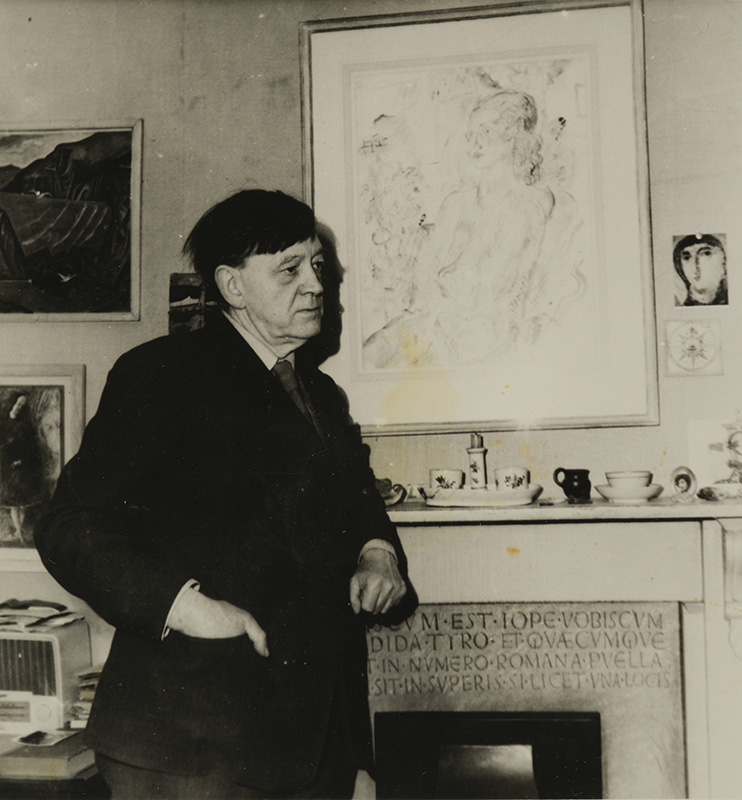
Cloelia and Cornelia are the first in a list of female figures Jones celebrates in the inscription. Cloelia was a maiden who swam across the Tiber to safety while leading a group of fellow hostages held by the Etruscans. Cornelia, another ancient Roman figure, was the mother of the Gracchi brothers. For Jones, the two figures represent the entwinement of two kinds of women – the maiden and the mother – which are dually embodied by the Virgin Mary, whom the inscription celebrates. The other women referenced on the inscription are also virgins or mothers. Rhiannon is a mother-goddess from Welsh mythology and Arianrhod is, like Mary, a virgin mother. Eigr is an early version of Igerna, the Welsh form of Igraine, mother of Arthur. Essyllt is the Welsh iteration of Isolde, whom Jones painted in 1962. These women are paralleled with Mary, who is alluded to in the ‘fields of Ephrata’ line, as Ephrata is an alternate name for Bethlehem. Thus, Mary becomes ‘the most exalted girl of all/The holy guardian and mistress of the world,’ celebrated on the Christmas greeting. Cloelia Cornelia combines lines from a variety of works in both English and Latin with these references to important mythic and literary female figures. The inscription’s opening line, for example, is from Lord Alfred Tennyson’s poem The Princess (1847), where Cloelia and Cornelia appear as statues at Princess Ida’s women’s university. Other literary references include the ancient Roman elegiac poet Propertius and 14th century poet William Langland, author of Piers Plowman. Reproduced as a Christmas card in 1959 and later carved in part above Jones’s fireplace, Cloelia Cornelia was a favoured inscription of Jones’s.