Christmas 1955 was a special time in Cardiff. The city's shops were busy, Christmas lights decorated the streets and carol services filled the chapels, churches and the cathedral. Cardiff, like the rest of Britain, had come out of a period of austerity following the Second World War and was beginning to enjoy a period of wealth with rising living standards.
But there was a special feeling in the city at Christmas 1955 because it had just been declared as the Capital of Wales.
The rise of a Welsh identity in the nineteenth and early twentieth centuries had led to the establishment of several national bodies, the National Museum, The National Library and the University of Wales together with the National Eisteddfod and as a result of the disestablishment of the Anglican church, the Church in Wales had joined the party. What Wales was missing was a capital.
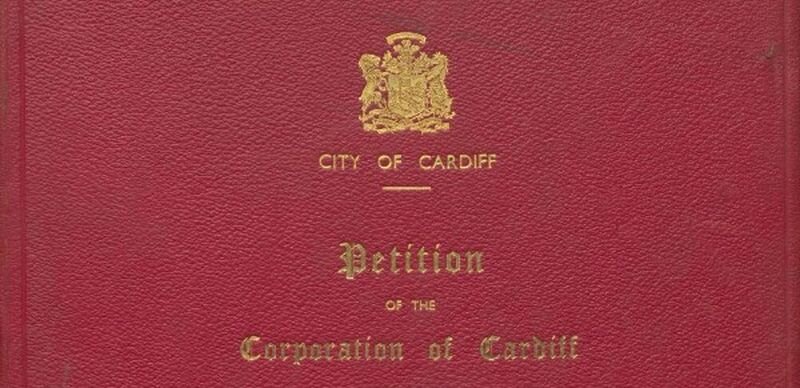
There were several attempts to recognize a capital of Wales and many of the stories are available in the archival and print collections in the Library. The South Wales Daily News surveyed Welsh local authorities in the 1930s and recorded 76 of 161 favouring Cardiff and Cardiff itself presented a petition to King George VI in 1949 asking him to grant the city capital status.
The document was bilingual and full of information to justify capital status noting the importance of Cardiff to business, administration, religion and education in Wales and was signed by the Town Clerk and the Lord Mayor. But nothing happened.
Following the 1951 General Election, the Conservatives, who had promised a number of Welsh measures including appointing a Minister for Welsh Affairs, formed a government, hopes were raised. The Council for Wales and Monmouthshire asked local authorities to submit applications and several were received. Cardiff presented its application for the second time with an address to the members of the Council for Wales and Monmouthshire along with a personal copy to the chairman of the Council, Huw T. Edwards. Again nothing happened.
There was another vote among local authorities in 1955, with 134 of 161 supporting Cardiff.
Then, a few days before Christmas, one of the city's Members of Parliament, Sir David Treharne-Llewellyn, asked the Home Secretary and Minister for Welsh Affairs, Gwilym Lloyd George, a question whether the Government had made a decision on the capital of Wales. Lloyd George’s answer broke the long official silence:
‘The Government have been impressed by the volume of support in Wales for the view that Cardiff is the city which should most appropriately be regarded as the capital of Wales, and in deference to these views the Government are prepared to recognize Cardiff as the capital of the Principality. No formal measures are necessary to give effect to this decision.’
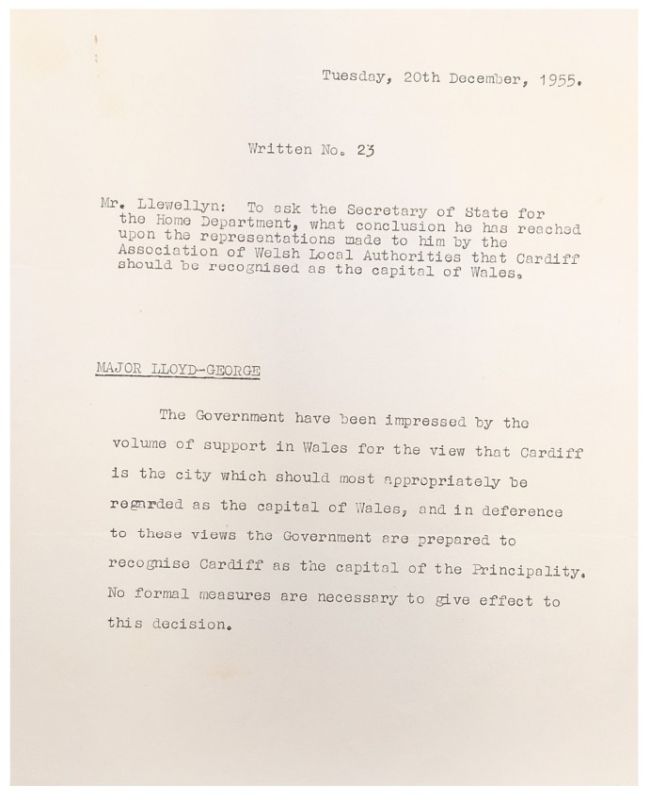
And that was it! With nothing more than a statement to the House of Commons, Cardiff was a capital city. Perhaps such an announcement was not a fitting climax to the story, but in two sentences, Gwilym Lloyd George had given Cardiff a superb Christmas present.
Category: Article