
100 years ago, in 1925, two significant moments in the history of Welsh film happened: the pioneering William Haggar died, and the ground-breaking Jerry the Tyke was ‘born’. In this blog we’ll take a look at the significance of both Haggar and Jerry to cinema history in Wales, and beyond.
William Haggar was born in Essex in 1851 and, through a difficult but creative childhood, established a travelling theatre company by age 20. Haggar moved with the company across the UK but settled in Wales, where he found enthusiastic and receptive crowds.
Soon incorporating the relatively very new technology of film projection into his touring show, Haggar’s travelling cinema, The Bioscope was hugely popular at south Wales’ fairgrounds. In order to populate his film shows, Haggar quite naturally started making his own. Haggar’s family members were all part of his stock company, which gave him an edge on other early filmmakers who did not necessarily have actors at their disposal.
Haggar's films often featured violence and humour, much to the delight of his audiences, building on his background in theatre, which was often grand-guignolesque. Haggar made more than 30 known films, many of which were distributed across the UK by British Gaumont. Sadly, only a handful survive today, and we’re fortunate to be custodians of them. Three can be seen on the BFI Player:
The Bathers' Revenge (1904)
Revenge! (1904)
The Sheep Stealer (1908)
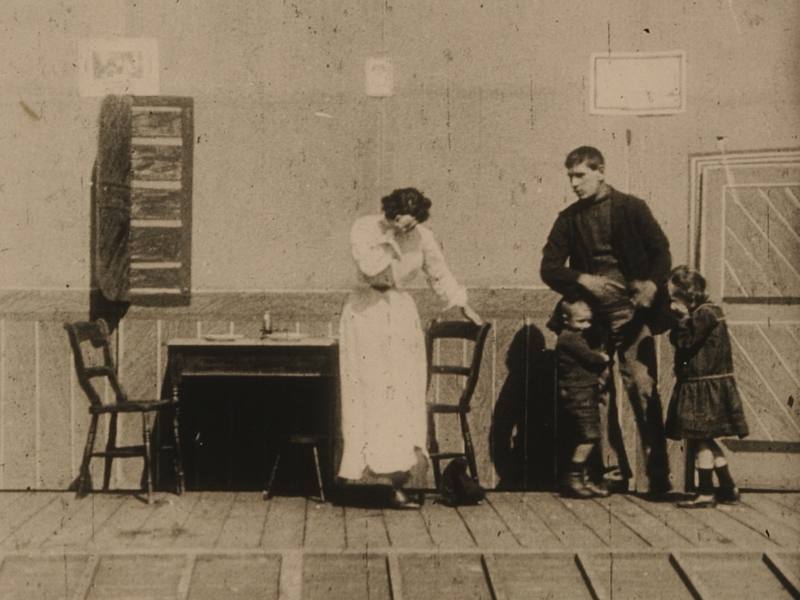
We also have 35mm copies of A Desperate Poaching Affray (1903) and The Life of Charles Peace (1905) thanks to the BFI, and an SVHS copy of the surviving fragment of A Message from the Sea (1905), which can be seen on the People’s Collection Wales website.
Haggar later went on to own a chain of cinemas in Llanelli, Pontarddulais, Neath, Mountain Ash and Pembroke. He died in 1925, but his experienced family members would continue his legacy: his sons James and William Jnr. Both made their own films, such as the Llanelli topical The Shop Assistants’ Outing to Ilfracombe (1913), of which a fragment survives; and the once lost Love Story of Ann Thomas, the Maid of Cefn Ydfa (1914).
While one of early Welsh cinema’s stars dimmed in 1925, so another was born: animated dog Jerry the Troublesome Tyke was first produced in 1925, in a mixture of live-action and animation. Jerry was created by animator Sid Griffiths and photographer Bert Bilby, who both worked as projectionists at Cardiff's Capitol Cinema.
They made animated short films between 1925 and 1927, which were shown all over the world as part of Pathé Pictorial, a fortnightly cinema news magazine. Each silent short lasted for about four minutes and often featured Griffiths himself interacting with Jerry, though Jerry always remained on the drawn page.
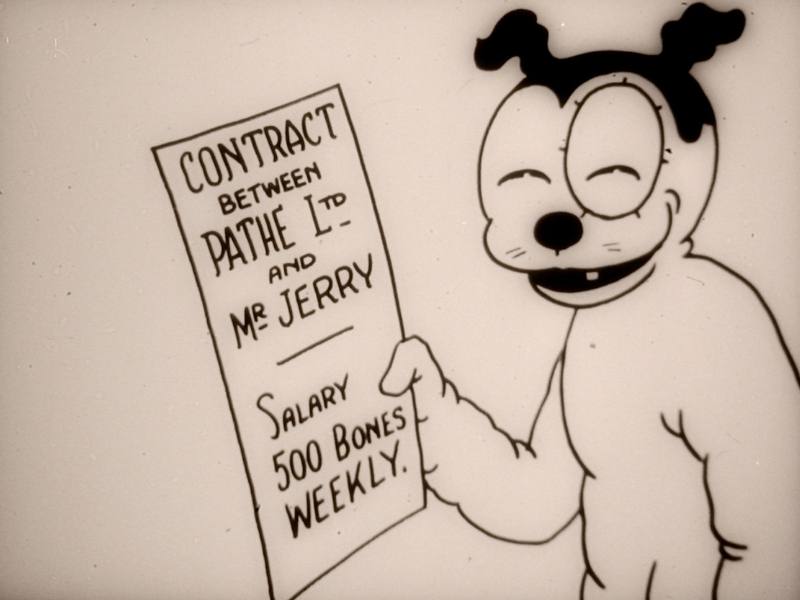
Jerry is recognised as being the first animated series made in Wales, and he emerged at a time when film companies very often had their own signature animated character, such as Mickey Mouse for Walt Disney Studios and Felix the Cat for Paramount Pictures – and so Jerry represented Pathé News.
All 42 Jerry the Troublesome Tyke films can be seen on the British Pathé website, including the very first instalment, which was included in Pathe Pictorial 382, July 27th 1925.
In the first film we’re shown the ‘birth’ of Jerry – a creative sequence in which a nib and an inkpot bring Jerry to life. Sid then insists that Jerry learn to ride a horse so that he can gain a Pathé contract, a process that’s both violent and funny, setting up the sense of mischief Jerry will continue to embody.
Common to both Jerry and the films of William Haggar – in addition to their pioneering status – is the mischief and subversion often found in early cinema, particularly a disregard for perceived authority. This overwhelming sense of daring would soon be overtaken by growing notions of quality and good taste in cinema, and in times of growing cultural hegemony being able to look back at the irreverence and daring of these pioneers is all the more important.
References
David Berry, Wales and Cinema: The First Hundred Years, 1994
William Haggar Fairground Film Maker: Biography of a pioneer of the cinema, 2007
Category: Article