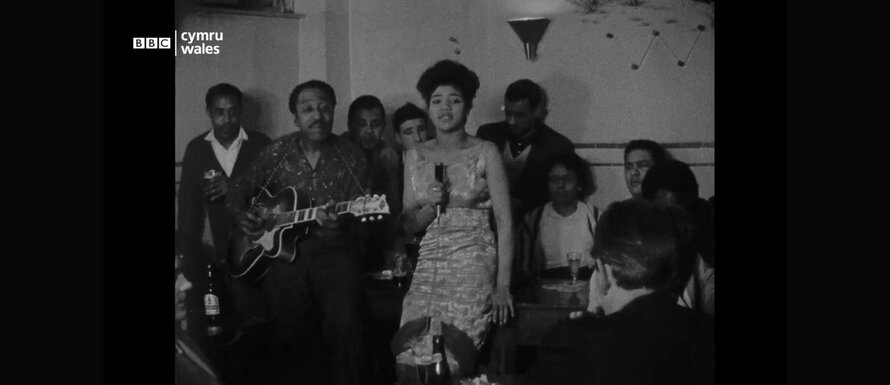
I’ve worked on curating Black History in Wales, a playlist for the home page of Watch and Listen. Focusing in on Black history in Wales specifically, it draws from decades of broadcast material, taken from our collections of off-air recordings as well as clips and programmes from the Wales Broadcast Archive.
The playlist of course represents only a small selection of the material in the archive, but nevertheless it represents both the stories of Black history in Wales contained in the items, and the history of representations of Black history as well.
While there are several items in the playlist from the 2020s, reflecting the huge institutional response to the prominence of the Black Lives Matter movement of the early 2020s, it’s worth drawing attention to the long history of programmes about Black history in Welsh media. We might consider how these have changed over time (or not!), from the earliest items in the playlist, 1962, and the latest, from 2024. The range of material also demonstrates a shift in who gets to tell who’s history.
There is perhaps also an over-representation of Butetown, or Tiger Bay, relatively speaking, which is itself a reflection of how Black history has been represented in Welsh media over the decades. While naturally Wales’ oldest multicultural community should rightly receive ample focus, it is also only a stone’s throw away from the country’s media centre. Might more unique stories have received attention if those making programmes had been based elsewhere or travelled further? A more Wales-wide approach becomes apparent as the decades move on.
The playlist begins with Liana Stewart’s 2020 film, Black and Welsh (BBC, recorded off-air), a wide-ranging portrait of various people from across Wales, from Llanfair PG to Newport. As a film, it reflects conversations and topics that are found, both explicitly and implicitly in other programmes on this playlist. It includes a breadth of Black Welsh experience, from a Rastafarian beekeeper to a gay lawyer, and discussions around other people’s attitudes and what it means to identify as ‘Black’.
The history of Butetown is the focus of Wales’ Forgotten Race Riots (2020, BBC, recorded off-air), Tamed and Shabby Tiger (1968, BBC), Capital City (2005, BBC), Looking Forward (1985, ITV) and three clips of interviews with local residents (1962 & 2005, BBC).
In 1968 Selwyn Roderick produced Tamed and Shabby Tiger, a remarkable portrait of Tiger Bay in the latter stages of its redevelopment. Almost 40 years later, Roderick returned to make Capital City, revisiting Butetown to trace the further changes since his original film. Roderick speaks to school children who have just been shown Tamed and Shabby Tiger by their teacher, Betty Campbell, and speaks again to contributors from the first film, such as Olive Salaman. Many contributors reflect on the further (re)developments of the area and Cardiff more widely, and the impact disregarding the concerns of those who lived in the area had on the social and community connections of the neighbourhood.
Wales’ Forgotten Race Riots is a radio programme in which presenter Mo Jannah investigates the 1919 race riots that shook Cardiff. Though here presented as forgotten, there are other programmes in the archive, from S4C in the 90s and the 00s, that outline their history. But those are often voiced or presented by non-Black people and offer clumsy and even crass re-stagings of that history. Jannah’s programme, by contrast, is more sensitive and more effective for it.
The history of Butetown is of course multiethnic and multicultural, and in Looking Forward presenter Linda Mitchell hones in on a few things: the history of the 2nd Marquess of Bute’s land ownership and development in Cardiff and the valleys, the religious diversity of Butetown, and an interview with Steve, a young Sudanese man born in Wales. He speaks of his cultural connections to his roots and his Rastafarianism, as well as the economic difficulties facing his generation. Mitchell emphasises the difficulties Black people particularly face when seeking work, despite the supposed progress of the then relatively recently introduced Race Relations Act (1976). Nevertheless, Mitchell ends on a hopeful note with Butetown Carnival, a place where “being proud of the colour of your skin,” as she puts it, is encouraged.
Two special programmes focus on Black music in Wales: Slate (1993, BBC) and Black Music Wales (2024, BBC, recorded off-air). ‘Jazz in the Docks’ is a special programme of Slate, presented by Ali Yassine and specifically looking at the presence and influence of jazz in Tiger Bay. Though Black Music Wales is a much more contemporary programme, it too looks back to some Welsh greats of the past, including Iris Williams, elder musicians such as Anthony Ward, Eric Martin and Skindred, as well as current artists like Sage Todz, and the programme’s presenter Lemfreck.
Music features prominently too in Dilyn Ddoe (1999, S4C), a portrait of Paul Robeson and his relationship to the south Wales valleys. The programme includes an interview with Robeson’s son, Paul Jr., but primarily features contributions from miners and other people from the valleys who met him and knew him at the time. Though Robeson’s solidarity with the miners of south Wales is often reduced to token symbolism, the programme charts his background before his time in Wales, and the core of his anti-racist, socialist and anti-fascist politics are emphasised as an important part of his character.
Robeson also makes an appearance in Wales’ Black Miners (2020, BBC, recorded off-air), a documentary presented by football legend Nathan Blake. Whereas Robeson’s connection to the mines is relatively well-known, the stories of Black miners in Wales are less so. In this programme Blake travels across the valleys to meet some of these miners, and their families, to hear their stories and their experiences directly.
More personal history can be found in First Hand (2002, BBC), Pobol Cymru (2002, S4C) and Beti a’i Phobl (2023, BBC, recorded off-air). In First Hand, Charlotte Williams is interviewed at length about her then new book, Sugar and Slate. In the interview she talks more about the content of the book, from her parents, her childhood in north Wales, Black history in Wales, and various aspects of Afro-Caribbean identity as she’s experienced it. In Pobol Cymru, Bev Lennon, from south Wales, and Ffion Griffiths, from north Wales, talk about their lives, including their experiences as Black women. Pobol Cymru was a series part of the ‘Cymru 2000’ programming, tracing 20th century Welsh history. In an episode of long-running radio interview programme Beti a’i Phobl, actor Mali Ann Rees talks about her life and career, including her feelings on tokenism, especially around Black History Month and more so still in the wake of Black Lives Matter’s prominence in 2020.
The 15 programmes and clips contained in this playlist are a brief insight into Wales’ Black history and the way in which it has been presented in the media. In this playlist, it takes until 1985 for a Black person to present, and the 2020s for it to become more common.
This playlist is also limited to the material currently available on Watch and Listen, and points to the important role that access plays in promoting not just Black history, but the various histories contained in this material. The website is still relatively new, and over the coming months and years many more of our audiovisual collections will become much more readily available on it.
Category: Article