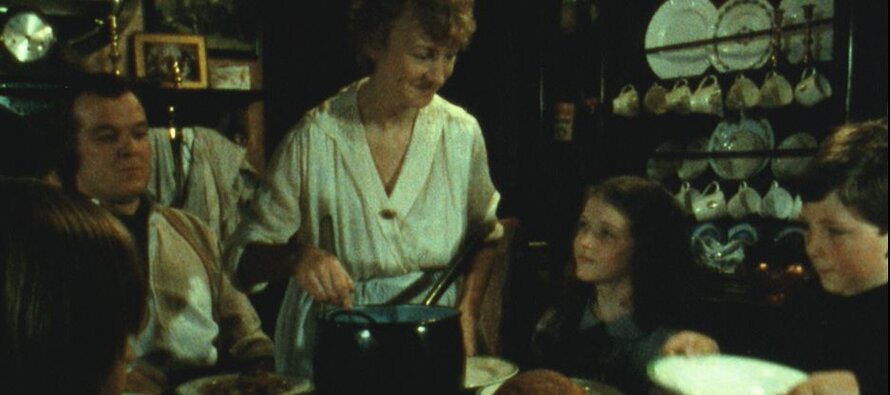
To mark International Women’s Day on March 8th, we’re showing a clip from the documentary film Mam (1988, Red Flannel Films) on the big screen in the Peniarth Room at the National Library of Wales throughout the month of March and beyond.
Through the eyes of mothers, daughters and historians, the film is an exploration of the image of the ‘Welsh Mam’, the sacrifices that women made, and their gradual emancipation through key moments in history.
The story begins in 1847, when the ‘Welsh working classes came under scrutiny’. Three Anglican commissioners were appointed to investigate the state of education in Wales. The commissioners, who had no knowledge of the Welsh people or their language concluded that educational standards needed to be improved, and the use of Welsh should be discouraged. Not only this, but also that ‘Welsh women were lacking in morals and domestic skills’. The report that resulted from the investigation became known as ‘Brad y Llyfrau Geision’, or ‘The Treachery of the Blue Books’, due to the influence the report had on the psyche of the Welsh people.
In Mam, opinion from the report is dramatised for us to hear. ‘Welsh women have no knowledge of housewifery or economy. The women are so sinful and immoral it is vain to expect virtue in their offspring..’ ‘It is the general practice amongst the women to take tea as early as four or five o'clock in the afternoon. For this, they make great use of each other's houses, and it is the occasion for much gossip and tattling.’
The opinion of the commissioners is clear, and caused a furore in Wales. In Mam, historian Diane Bianchi explains how contemporary writer Ieuan Gwynedd became convinced that there might actually be room for Welsh women to improve themselves, and started a periodical called ‘Y Gymraes’ (The Welsh Woman), in which he ‘set out to improve the morals of the women of our country and turn them into diligent and loving mothers.’
From this, the image of the ‘Welsh Mam’ began to emerge. ‘The mother is the angel in the home, the anchor of stability in an age of change and uncertainty. She is everything that is pure and good in Wales. Indeed she is Wales herself’.
So from this moment, the portrayal of the Welsh Mam was cemented in society. A ‘pacifier’, a ‘reconciler’, a ‘stabilising influence in an age of turbulence’, but, as Mam, shows, this badge of honour came with a huge amount of sacrifice for women in Wales.
They lost any standing they had in industry, and became the ‘keepers of the household’. Wales became one of the ‘most macho regions in Britain in terms of the definition of work’.
From hereon, women’s lives were pre-ordained. ‘You had children, you looked after a man, you done the housework, you knitted, you sewed, you washed, you ironed, and that was your life. Men was the provider and the woman had to stay in the home.’
The sacrifice was on many different levels – personal, educational, health, and a shocking statistic is revealed by historian Angela John, that despite the notoriously dangerous occupation of the miner, ‘..at the end of the 19th century, married women between 20 and 45 in the Rhondda actually had a higher rate of mortality, than did their own husband.’ ‘Childbirth itself was often a much more dangerous activity than actually working in the pit.’
Toiling from morning until night, cleaning, polishing, scrubbing, washing, cooking, women had no time for themselves. They managed the money in the household, often burdened with keeping things together when times were hard, making do and mending, and often going without food themselves to ensure that the rest of the family had enough to eat.
‘I know now, she really went without, because she'd be cooking the dinners. My father would come in. There'd always be something special for him. And I can hear her now. He'd say, "Where's yours, Mam?". I've had mine. But I think she wasn't the only one. I think many, many mothers went without in those days for their families to eat.’
During the general strike of 1926, households in England started advertising for ‘young girls’ to go and work in homes as domestics. Time were very hard, so girls were gladly sent away from Welsh homes, to work, and send money back to the family.
Clearly the education of girls suffered, and Esme Kitto spells out the reality. ‘Perhaps many of them wanted to be educated, but if there was a boy in the family, well, the money went to the boy because the boy had to be the main breadwinner while the sister had to stay in the house to see that he went through school then. And money had come from the (domestic) service, and went into the home, so the boy could be educated and he didn't have to work until he finished his education.’
Esme continues, ‘I would have liked to have had an education and gone out in the world, but it wasn't to be for me. Because my brother was coming behind, wasn't he? And all the money had to go for his education. I would have liked to have gone further and seen if I could have gone to college. But at the time, we were expected to leave school at 15 and get out and earn as soon as possible to put money into the home.’
It was during the Second World War that things started to change for women. Men were sent away to war, and women were needed to work in factories. Nurseries were built all over the country which gave mothers the freedom to pursue a working life, knowing that their children were being cared for. All of a sudden, the world changed for women, as Iris Waite and Alice Boxall explain, ‘..we went of course, it was a new thing for us, it was exciting.’ ‘It was as if they'd flung something off their shoulders. And although we were making these things for the war, it was a very happy time. It was one of the happiest times of my life.’
‘You was wrapped up in your husband and your children, and your shopping and your ironing and your washing and that was it. But going to the factory, you heard the news and you heard different things. A different life altogether.’
This was a life altering moment, for women, and for society in the valleys. Eyes were opened, and there was no going back, as Iris Waite demonstrates, ‘I was a bit - felt more equal now, in my own right, as I wasn't just a housewife. I was able to do other things as well and think for myself. After all, I'd have to do all the thinking for four and a half years on my own, and bring up my children on my own. And then suddenly then, your husband comes back and he's telling you what to do again.’
The post-war era came with its own challenges though. For those who decided to work, being a working woman wasn’t (isn’t) an easy thing to be. Feelings of guilt, judgement from others and inequality in the workplace were commonplace.
‘And this man said, "But you women," he said, "are only working for pin money." He said, "You're not working for real money like the men." Of course, I went beserk, I said, "No way am I working for pin money." I said, "I'm working to feed and clothe my kids." I said, "I'm giving them a better standard."
In some cases, women weren’t accepted into Unions, and became easy targets for mistreatment, a situation that was only gradually improved over time
The second pivotal moment came during the miner’s strikes during the 1980s. Women came out on the picket lines, experienced more of life, and in some cases, the tables were turned, and they became the breadwinners of the family, whilst the men were on strike. Sian James and Glynnis Evans explain, ‘I think (it) gave me confidence. Confidence in my own ability to trust my own word, to trust my own judgement. I think any woman that came through the strike and learned so much from the strike, basically just needed that nudge. And the worst I think seven months I've ever experienced of my own feelings, was the seven months after the strike was over, because I had gone then from being, living something for a year… To going back to just being back in the house and the four walls.’
The whole experience taught the communities in the valleys that women needed, and were very much capable of something else. Men started to experience, and maybe appreciate, the traditional role of wives and mothers, of the Mam.
Women started to thrive in the community, gained confidence, support groups were formed, and they began fighting back for fair treatment, both socially, and in the workplace. The world of education and training opened up, enabling women to gain new skills, and to embark on new careers that previously would have been out of reach.
They set about working to improve future prospects for valley, for their children, setting up their own small businesses and co-operatives. It seemed for the first time, women started to have more control over their lives.
Ellen Cronin illustrates her personal experience, ‘Before, even in the tenants' meeting at the beginning, I would just sit and nod my head and agree, you know. But now I believe that my opinion is important enough to be said… I didn’t have that much confidence before. And I think it's made a difference, not just in my life, but it's given my daughter a lot more confidence in seeing me doing something’.
Towards the end of Mam there is a certain reality in the concluding scenes, even though progress has been marked, the struggle continues, as Esme Kitto explains, ‘The Welsh men in the valleys are still Lord God Almighty and they like to think I can put my coat on and I'm off. And they don't look back once they're off. Not to ask, well, do you want me to help somebody tonight or not?’.
‘Women won't go back to the days of my mother, will they? Today women… they fight and they want to go and see things differently. And even a Welsh Mam is a sentimental idea really, of this is the way you should be like, and it's difficult to change that I think.’
The theme of International Women’s Day this year is ‘Give to Gain’, and Mam fits perfectly into this. Sacrifice, strength and striving for a better future are key throughout the story.
Nearly 40 years on from the making of this documentary, how have things progressed? Maybe it’s time to re-visit and reflect, and make a new film.
Category: Article