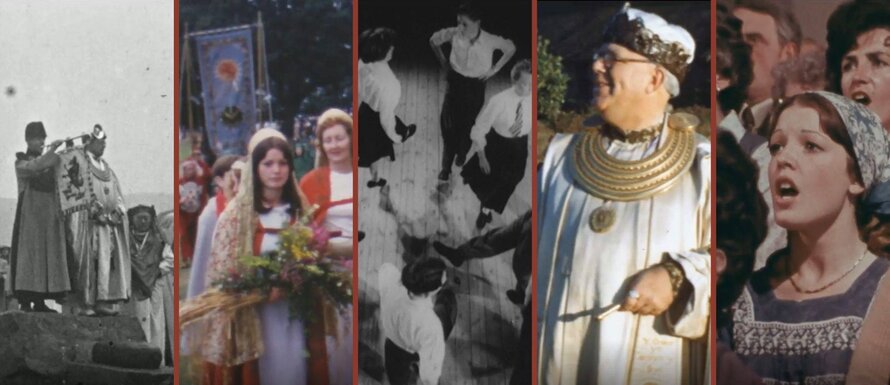
As part of this year's National Eisteddfod Sinemaes, a compilation of items from the Screen and Sound archive, including from the Wales Broadcast Archive, will be screened at various times during the festival. The selection celebrates the history of the Eisteddfod, as the festival reaches its 850-year milestone.
We don't have 850 years’ worth of material, of course, but the compilation represents 7 decades, offering a taste of the festival, from the preparation and the competition, to the nation’s greats and its grass-roots; the maes, the fun and the mischief.
Here is more information about the films and programmes included in the selection, which will also be available to watch in the Peniarth Room of the National Library of Wales in August. Many are also available to enjoy on Watch and Listen - some available from anywhere, but others only available in full within Clip Corners throughout Wales.
The clip that opens the selection comes from a special BBC documentary, Nod Cyfrin (BBC, 1981). In it, Gwyn Morgan Lloyd presents the history of the Gorsedd at the National Eisteddfod, paying particular attention to the significance of the stones and attire of the Gorsedd.
Following it comes a clip from Marie Gwalia (Topical Film Company, 1925), which follows the Queen of Romania's special visit to the Pwllheli Eisteddfod of 1925, including her induction into the Gorsedd. Accompanying her for this privilege is Winifred Coombe Tennant, Mistress of the Robes, and Dame Margaret Lloyd George. She also visits - in her usual, grand attire - Y Wern in Porthmadog, which was at the time the home of Richard Metheun Greaves, owner of the Llechwedd quarry.
In Machynlleth, Hen Dref Owain Glyndŵr (1937) we see choirs on the field, led by stewards in white jackets, as well as some famous people, including David Lloyd George. Once again the Gorsedd gets a lot of attention, as we get to see a ceremony at the Gorsedd stones, and the procession to the chairing ceremony. This film was specially produced to be shown at the Powys Cinema, which used to stand on Heol Powys, before it was demolished.
Similar scenes can be seen from the Swansea Eisteddfod, 1925, in Dear Cambria (British Screen Productions Ltd., 1926). As well as views of the town and the Gorsedd in procession, we see the Duke and Duchess of York - later King George VI and Queen Elizabeth - being admitted to the Gorsedd under their bardic names, 'Albert of York' and 'Betsi of York'.
Another travel film is Spotlight on Wales (Rayant Pictures, 1949), which focuses on the Dolgellau Eisteddfod, 1949. We see crowds of people arriving at the field from Dolgellau train station, as well as cars and buses being guided to car parks near the field.
A significant event at the 1949 Eisteddfod was the premiere of the next film, Yr Etifeddiaeth (John Roberts Williams). It is a patriotic film about the heritage of Wales which is recognized as a classic of the period. The film is narrated by Cynan, and in this clip he introduces the viewers to the National Eisteddfod - including the visitors’ tendency to spot plenty of familiar faces on the maes!
The scenes from Aberystwyth come from Evan Caradoc Roberts' personal film, Eisteddfod Genedlaethol Frenhinol Cymru Aberystwyth (1952), where the enthusiastic crowd gathers in Plascrug park and avenue, where the maes is located. Roberts was an accountant at the National Library of Wales, and he had won the first prize for woodwork at the 1947 Eisteddfod for his model of the Library, which had taken him 5 months to build!
That famous artist, known for his paintings of wildlife, especially birds, Charles F. Tunnicliffe, is behind the camera that captures the proclamation ceremony of the Eisteddfod in Pwllheli, 1955 in Proclamation 1954: National Eisteddfod in Pwllheli 1955. In the film the Archdruid, Cynan (Albert Evans-Jones) embraces the opportunity to pose for the camera in his grand ceremonial dress.
In The Royal National Eisteddfod of Wales (Pat Pullen, 1958) we see school children practising their dance and instrumental performances and scenes from the maes and stage of the Ebbw Vale Eisteddfod, 1958. The film was produced by Richard Thomas and Baldwins Ltd., the steel company from Ebbw Vale; the film was directed by Pat Pullen.
R. Alun Evans presented Heddiw Ddoe (BBC,1982), and here introduces a clip from the Newtown Eisteddfod, 1965, where the Archdruid Cynan chaired W.D. Williams of the Barmouth. Williams' winning awdl was inspired by his son Iolo's trip to see the Lascaux caves in France.
The polymath Owain Owain filmed his family enjoying the Bala Eisteddfod, 1967 in Teulu Owain Owain: Llanuwchllyn and Bala, which includes scenes from the stand of Cymdeithas yr Iaith, the organization he was a key part of establishing. There is also focus on his children in a play area near the 'Arts and Crafts' tent, where quite a crowd has gathered in the sun.
At Eisteddfod Bangor (John Glyn Jones, 1971) we get to see scenes from the maes, including a distant view of Penrhyn Castle, stallholders, the chairing of Emrys Roberts, and the Gorsedd parade - and a protest by Cymdeithas yr Iaith members. Dafydd Iwan is among the protesters, and in the same year he was accepted as an honorary member of the Gorsedd y Beirdd.
The fairly controversial moment of Alan Llwyd being chaired at the Cardigan Eisteddfod 1976 - the 800th Eisteddfod - after the discovery that the original winner, Dic Jones, had broken the rules of the competition, is part of A Celtic Celebration (Revel Guest & Euryn Ogwen Williams, 1976). There are also scenes of recitation and choral practice, and the 1976 festival was known as 'Eisteddfod y Llwch' because of that year's heat wave. Could this year prove similar?
Chapter Video Workshop produced UB40 - Eisteddfod Abergwaun (1986), a piece that examines the attitudes of attendees of Fishguard Eisteddfod of 1986 about their opinion on the entrance fees to the field and whether discounts should be available to unemployed people. The entrance fee to the field was £2.50 at the time. The 'UB40' referred to in the title of course refers to the attendance card issued to unemployment benefit claimants at the time.
To conclude our compilation there is a clip from the 90s which really gives a taste of the era. From an episode of Eisteddfod iDot (S4C, 1996), there is an early performance by the Super Furry Animals of their song 'Crys Ti', which very neatly leads to a montage of t-shirts from the iconic company, Cowbois, being modelled across the maes.
From 1925 to 1996, the selection compiled by the archive this year hopes to capture some of the National Eisteddfod’s journey – bumps and magic included. Although the maes, the Gorsedd, and the ceremonies dominate, there is also a glimpse here of other things: the preparation, the debate, the fun, the culture.
You can watch the selection in Sinemaes at the Eisteddfod, and in the Peniarth Room of the National Library throughout August, and many of the clips, films and programmes are available on Watch and Listen - plus quite a bit more! What Eisteddfod stories will you discover?
Category: Article